
React.js Latest Features and Best Practices in 2026
26th January 2026
The Role of a Quality Analyst and Why Quality Assurance Is Important for Business Growth
6th February 2026
The journey from complete beginner to skilled developer might seem daunting, but thousands of people make this transition every year. Whether you’re switching careers, fresh out of school, or simply curious about coding, this roadmap will guide you through the essential steps to becoming a proficient developer.
Understanding What “Developer” Really Means
Before diving in, it’s important to recognize that “developer” is a broad term. You could become a web developer, mobile app developer, game developer, data engineer, or specialize in dozens of other areas. The good news? The fundamental skills overlap significantly, so you can start with the basics and specialize later.
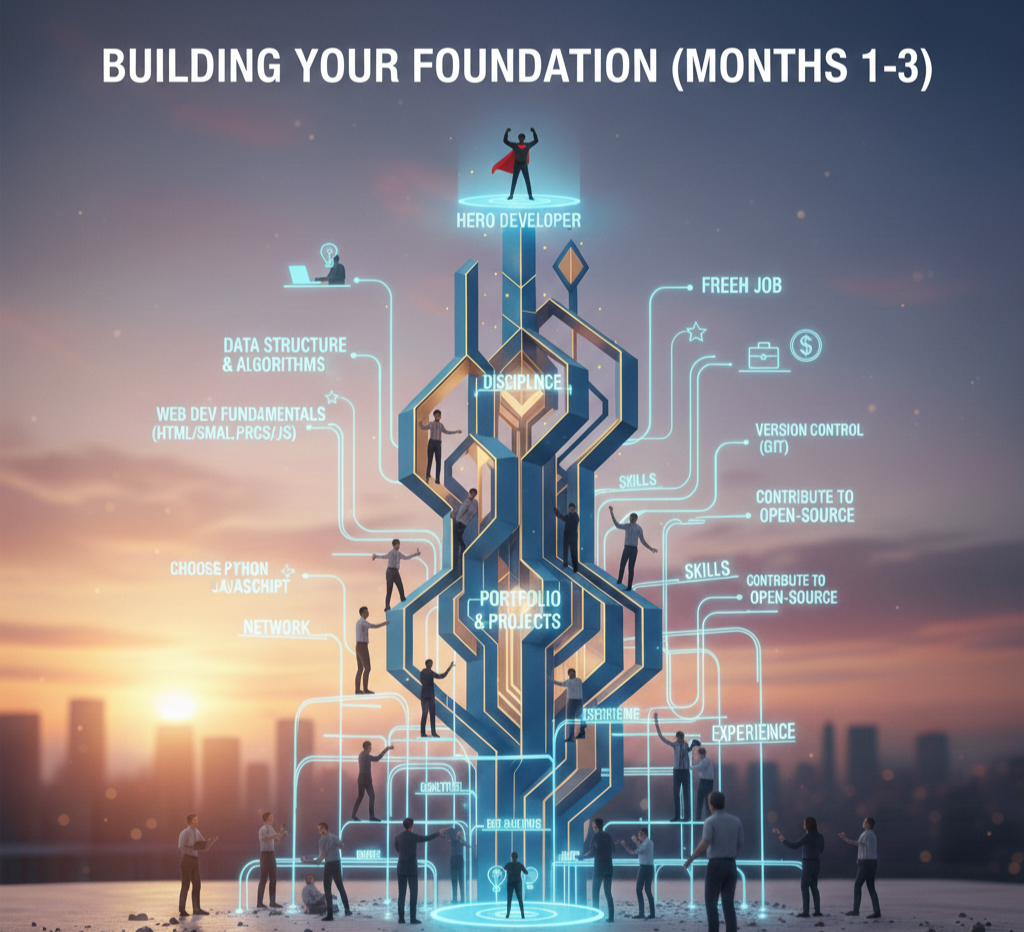
Phase 1: Building Your Foundation (Months 1-3)
Choose Your First Programming Language
Your first language should balance being beginner-friendly with practical utility. Popular starting points include:
- Python : Excellent for beginners, widely used in web development, data science, and automation
- JavaScript : Essential for web development, runs in every browser
- Java or C# : Great for understanding computer science fundamentals
Don’t get paralyzed by choice. Pick one and commit to it for at least a few months. You can always learn additional languages later, and the second language is always easier than the first.
Master the Fundamentals
Focus on core programming concepts that apply across all languages:
- Variables and data types
- Control structures (if statements, loops)
- Functions and methods
- Data structures (arrays, objects, lists)
- Basic algorithms
- Error handling
Free Resources to Get Started
– freeCodeCamp offers comprehensive, interactive course
– Codecademy provides hands-on coding exercises
– The Odin Project offers a full-stack curriculum
– CS50 from Harvard gives you computer science fundamentals
– YouTube channels like Traversy Media and Programming with Mosh offer excellent tutorials
Build Your First Projects
Theory only takes you so far. Start building simple projects like:
- A calculator
- A to-do list application
- A simple game (tic-tac-toe, rock-paper-scissors)
- A personal website or portfolio
These projects cement your understanding and give you something tangible to show for your learning.

Phase 2: Deepening Your Skills (Months 4-8)
Learn Version Control
Git and GitHub are non-negotiable tools in modern development. Understanding how to:
- Create repositories
- Commit changes
- Work with branches
- Collaborate with others
- Manage merge conflicts
This knowledge is essential for both solo projects and team collaboration.
Choose a Specialization Path
By now, you should have enough experience to know what interests you:
Web Development : Learn HTML, CSS, and JavaScript deeply. Explore frameworks like React, Vue, or Angular for frontend work. For backend, consider Node.js, Django, or Ruby on Rails.
Mobile Development : Choose between native development (Swift for iOS, Kotlin for Android) or cross-platform frameworks (React Native, Flutter).
Data Science/Machine Learning : Deepen your Python skills and learn libraries like NumPy, Pandas, and scikit-learn.
Game Development : Explore Unity (C#) or Unreal Engine (C++).
Understand Databases
Nearly every application needs to store data. Learn:
– SQL basics and relational database concepts (PostgreSQL, MySQL)
– How to design database schemas
– Basic NoSQL databases (MongoDB, Firebase)
Build More Complex Projects
Create applications that solve real problems:
- A blog or content management system
- An e-commerce site
- A social media clone
- A weather app that uses APIs
- A task management application

Phase 3: Professional Development (Months 9-12)
Learn Best Practices
Professional code isn’t just about making things work:
- Write clean, readable code
- Follow naming conventions and style guides
- Add comments and documentation
- Write tests for your code
- Understand design patterns
- Learn about software architecture
Contribute to Open Source
Open source contributions provide real-world experience and look impressive to employers:
– Find beginner-friendly projects on GitHub
– Start with documentation or small bug fixes
– Gradually tackle more complex issues
– Learn from code reviews
Build Your Portfolio
Create 3-5 polished projects that demonstrate your skills:
– Make sure they’re fully functional
– Write clear README files
– Deploy them so others can use them
– Host your code on GitHub
Network and Engage with the Community
Development is a collaborative field:
– Attend local meetups or virtual conferences
– Join Discord servers and online communities
– Follow developers on Twitter/X and LinkedIn
– Share your learning journey on social media or a blog
Prepare for Technical Interviews
The job search requires specific preparation:
– Practice coding challenges on LeetCode, HackerRank, or CodeWars
– Study data structures and algorithms
– Do mock interviews
– Prepare to explain your projects and decisions
– Build communication skills
Phase 4: Landing Your First Role
Craft Your Application Materials
– Create a professional resume highlighting projects and skills
– Write a compelling cover letter for each application
– Ensure your LinkedIn profile is complete
– Make your GitHub profile presentable
Where to Look
- Job boards (Indeed, LinkedIn, AngelList)
- Company career pages
- Networking connections
- Tech-specific job sites (Stack Overflow Jobs, We Work Remotely)
- Bootcamp job placement programs
Consider Alternative Entry Points
If traditional jobs prove elusive initially:
– Freelancing on Upwork or Fiverr
– Internships, even unpaid ones for experience
– Contributing to open source
– Building products independently
– Contract or temporary positions
Continuing Your Growth as a Developer
Reaching your first developer job isn’t the finish line, it’s the starting line. The technology landscape constantly evolves, so embrace lifelong learning:
– Stay current with new technologies and best practices
– Attend conferences and workshops
– Read technical blogs and documentation
– Take on challenging projects that push your boundaries
– Mentor others as you grow
Common Pitfalls to Avoid
Tutorial Hell : Watching endless tutorials without building your own projects. Force yourself to build things independently.
Trying to Learn Everything : Focus and depth beat breadth for beginners. Master one thing before moving to the next.
Avoiding the Hard Parts : Struggling is part of learning. Don’t skip topics because they’re difficult.
Comparing Yourself to Others : Everyone learns at their own pace. Focus on your progress, not others’ timelines.
Not Asking for Help : The developer community is generally helpful. Use Stack Overflow, Reddit, and Discord when you’re stuck.
The Reality Check
Becoming a developer from zero typically takes 6-12 months of consistent, focused effort if you’re learning full-time, or 12-24 months part-time. Some people move faster, others take longer. The timeline matters less than the consistency and quality of your learning.
You will experience:
– Frustration when code doesn’t work
– Imposter syndrome
– Moments of confusion
– The joy of solving complex problems
– The satisfaction of building something from nothing
Every successful developer has been exactly where you are now. The difference between those who make it and those who don’t often comes down to persistence and consistency.
Final Thoughts
The path from zero to hero developer is challenging but absolutely achievable. You don’t need a computer science degree, expensive bootcamps, or special talent. You need curiosity, dedication, and the willingness to embrace discomfort as you learn.
Start today. Write your first “Hello, World!” program. Build something small. Make mistakes and learn from them. Before you know it, you’ll look back and realize how far you’ve come.
The best developers aren’t those who know everything—they’re the ones who know how to figure things out. Welcome to a career of continuous learning, problem-solving, and creation. Your journey from zero to hero starts now.