The Best Alternatives to Adobe Software in 2025
16th July 2025
Why Zustand Works Better Than Redux Toolkit in React
22nd July 2025How to Pick the Perfect Thinking Style: Finding What Works for You!

We all think — but we don’t all think the same. Some of us love data and logic, others thrive on creativity and emotion. Some people enjoy brainstorming out loud, while others prefer quietly analyzing things on their own. These differences make up our “thinking styles” — the mental habits and preferences that shape how we solve problems, make decisions, and communicate ideas.
But here’s the twist: no thinking style is the best. The real magic lies in finding the style that suits you — your personality, your work, your goals. In this blog, we’ll explore how to identify your natural thinking style and how to pick (and even switch) styles to better navigate life and work.
What Is a Thinking Style?

A thinking style is a pattern or approach you use when processing information. It includes how you:
- Perceive the world
- Solve problems
- Make decisions
- Communicate ideas
- Work with others
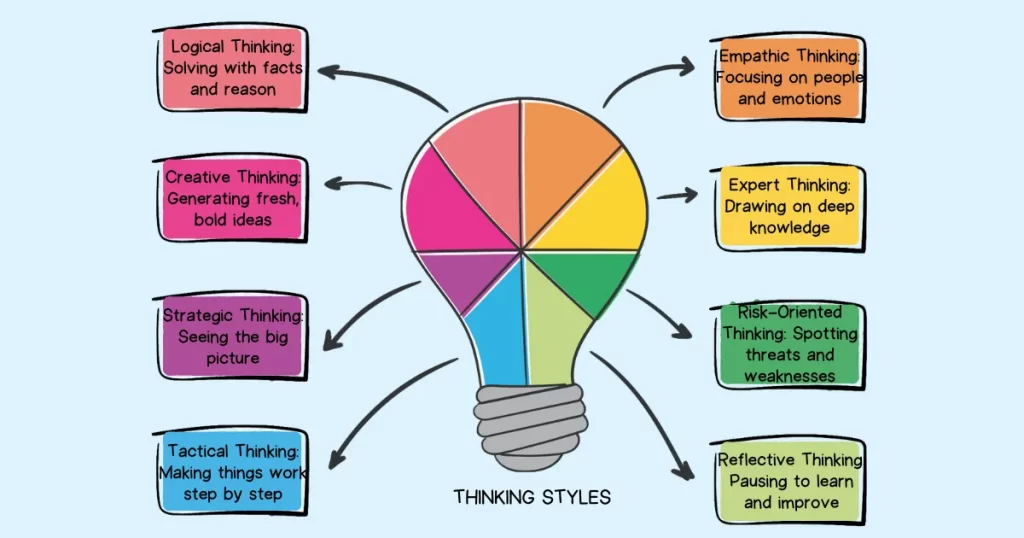
Some common thinking styles include:
- Analytical Thinkers: Logical, detail-oriented, data-driven
- Creative Thinkers: Imaginative, abstract, spontaneous
- Practical Thinkers: Grounded, hands-on, results-focused
- Reflective Thinkers: Thoughtful, introspective, big-picture
- Emotional Thinkers: Empathetic, intuitive, people-first
Why Your Thinking Style Matters
Your thinking style impacts:
- How you work: Structured or spontaneous? Collaborative or independent?
- How you lead: Facts-first or feelings-first? Risk-taker or cautious planner?
- How you learn: Visual or verbal? Hands-on or theoretical?
- How you relate to others: Harmony-driven or challenge-driven?
Understanding your thinking style helps you:
- Make better decisions
- Play to your strengths
- Communicate more effectively
- Choose the right roles, tasks, and even career paths
How to Identify Your Thinking Style
Here are a few ways to figure out your natural thinking preferences:
1. Reflect on Past Successes
Think about a time when you solved a tough problem or felt “in the zone.” What approach did you take? Were you systematic or spontaneous? Did you rely on facts, intuition, or creativity?
2. Take a Thinking Style Assessment
There are many free tools online that assess cognitive preferences. Tools like the Herrmann Brain Dominance Instrument (HBDI), Whole Brain Thinking, or even basic personality tests (like MBTI) can offer insights.
3. Ask for Feedback
Sometimes, others can spot patterns you can’t. Ask colleagues, friends, or mentors how they perceive your approach to problem-solving and communication.
4. Notice Your Energy Zones
When do you feel most energized — when organizing spreadsheets, sketching ideas, helping others, or solving logical puzzles? Energy can be a great indicator of style.
How to Pick (or Switch) the Right Style
Your default thinking style might not always be the best fit for every situation. Here’s how to flex your thinking muscles:
✔ For Creative Tasks:
Shift into divergent thinking. Brainstorm without limits, suspend judgment, and let ideas flow freely. Use mind maps or visual cues.
✔ For Decision-Making:
Use analytical thinking. List pros and cons, evaluate data, compare outcomes, and apply logic.
✔ For Leadership and People Management:
Tap into emotional and reflective thinking. Empathy, emotional intelligence, and perspective-taking go a long way.
✔ For Planning and Execution:
Engage your practical side. Set goals, build timelines, break projects into tasks, and focus on what works.
Blending Styles: The Ultimate Edge
The most effective thinkers are not locked into one style — they’re adaptive. They know when to shift gears and how to balance logic with creativity, intuition with analysis.
For example, great innovators often:
- Dream big like creative thinkers
- Plan like practical thinkers
- Reflect like big-picture thinkers
- Execute with analytical precision
Final Thoughts: Think Smarter, Not Harder
There’s no one-size-fits-all approach to thinking. The key is to understand your natural preferences, develop self-awareness, and stay flexible. Whether you’re solving a problem at work, making a life decision, or planning your next big idea — choosing the right thinking style can make all the difference.
So, what’s your perfect thinking style?
For Similar Blogs: Click
Contact Us: Click