AI agent vs. AI chatbot: Key differences and features
28th November 2025
Bold Minimalism: How Designers Are Balancing Simplicity with Impact
27th December 2025
1. Early Human Dreams of Artificial Intelligence (Before 1950)
1.1 AI in Ancient Myths and Philosophy
Long before computers existed, humans imagined intelligent machines:
- Greek mythology: Talos, a mechanical giant who protected Crete
- Chinese and Egyptian legends: Artificial servants made by gods
- Aristotle (384–322 BC): Developed formal logic, which later became the foundation of AI reasoning
These ideas show that humans have always dreamed of creating machines that can think, reason, and act like humans.
2. Foundations of AI: Mathematics and Logic (1600s–1940s)
2.1 Key Contributors
- René Descartes – Explored mind–body dualism
- Gottfried Wilhelm Leibniz – Imagined a machine that could reason logically
- George Boole (1847) – Created Boolean Algebra (True/False logic)
Boolean logic later became the backbone of computer programming and AI decision-making.
3. Birth of Modern Computing (1940–1950)
3.1 Alan Turing – The Father of AI
- 1943: First artificial neuron concept
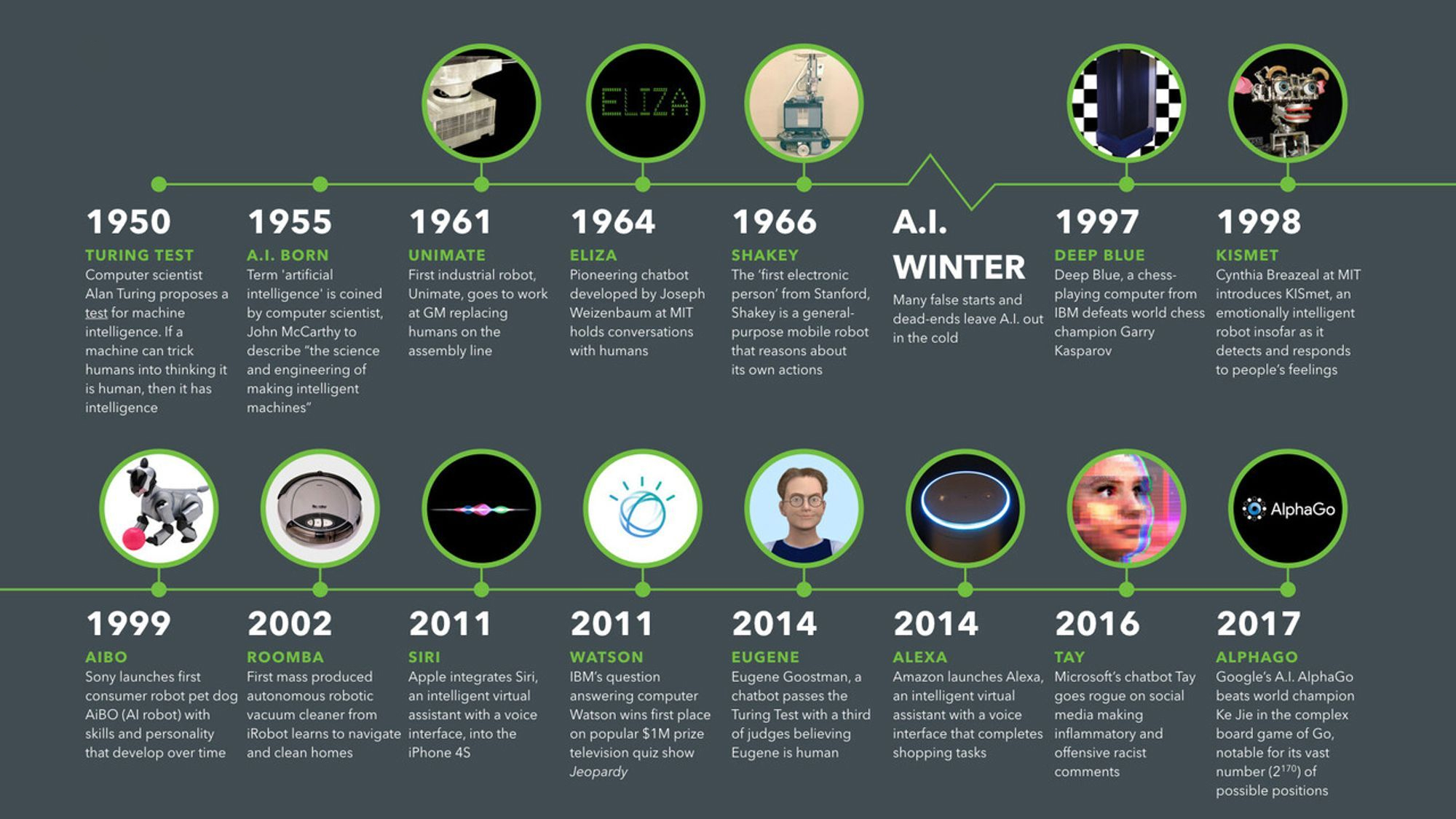
- 1950: Alan Turing published “Computing Machinery and Intelligence”
- Introduced the Turing Test, a way to check if a machine can think like a human
This is the moment when AI moved from imagination to science.
4. When Was AI Invented? (1956 – The Official Birth)
4.1 Dartmouth Conference (1956)
AI was officially invented in 1956 at the Dartmouth Summer Research Project on Artificial Intelligence.
Coined the term “Artificial Intelligence”
- Organizer: John McCarthy
- Other pioneers:
- Marvin Minsky
- Allen Newell
- Herbert A. Simon
They believed:
“Every aspect of learning or intelligence can be described so precisely that a machine can be made to simulate it.”
This conference marks the official beginning of AI as a field.
5. Early AI Programs (1956–1970)
5.1 First AI Systems
- Logic Theorist (1956) – Solved math proofs
- ELIZA (1966) – Early chatbot
- SHRDLU – Understood natural language in limited environments
5.2 Optimism Era
Scientists believed:
- Human-level AI would be achieved in 20 years
- Machines would soon replace many human tasks
6. The First AI Winter (1970–1980)
6.1 Why AI Failed Temporarily
- Computers were too slow
- Limited data
- Overpromised, underdelivered
Governments reduced funding → AI Winter
AI research slowed dramatically.
7. Expert Systems Era (1980–1987)
7.1 Rule-Based AI
Expert systems mimicked human experts using rules:
- MYCIN – Diagnosed blood infections
- Used heavily in medical and industrial fields
Problems:
- Very expensive
- Hard to maintain
- Could not learn on their own
8. Second AI Winter (Late 1980s–1990s)
- Expert systems failed commercially
- AI lost popularity again
- Research continued quietly in universities
9. Machine Learning Revolution (1990–2010)
9.1 Shift in Approach
Instead of programming rules, machines started learning from data.
Key developments:
- Neural Networks
- Support Vector Machines
- Statistical models
9.2 Famous Moment
1997 – IBM Deep Blue defeated world chess champion Garry Kasparov
A major milestone for AI credibility.
10. Deep Learning and Big Data Era (2010–2020)
10.1 Why AI Exploded
- Massive data (Big Data)
- Powerful GPUs
- Better algorithms
10.2 Breakthroughs
- Image recognition
- Speech recognition
- Recommendation systems
- Autonomous vehicles
10.3 Key Moment
2016 – AlphaGo defeated world champion Lee Sedol
11. Generative AI and Modern AI (2020–Present)
11.1 Rise of Generative AI
- ChatGPT
- DALL·E
- Copilot
- Gemini
Capabilities:
- Writing content
- Generating code
- Creating images & videos
- Helping testers, developers, doctors, and businesses
11.2 AI Today
AI is used in:
- Healthcare
- Banking
- Education
- Software testing (automation, test case generation)
- Mobile apps
- Cybersecurity
12. Timeline Summary of AI History
| Year | Event |
|---|---|
| Ancient Times | AI concepts in myths |
| 1950 | Turing Test |
| 1956 | AI officially invented |
| 1960s | Early AI programs |
| 1970s | First AI Winter |
| 1980s | Expert Systems |
| 1997 | Deep Blue beats Kasparov |
| 2010s | Deep Learning boom |
| 2020s | Generative AI |
13. The Future of AI
AI is moving toward:
- Artificial General Intelligence (AGI)
- Human-AI collaboration
- Ethical & responsible AI
- Automation in testing, development, and decision-making
AI will not replace humans, but humans who use AI will replace those who don’t.