

Deploy Your React App to AWS with GitHub Actions: The Complete CI/CD Guide for 2026
24 April 2026
Goodbye REST & GraphQL — tRPC + Zod is the Stack of 2026
27 May 2026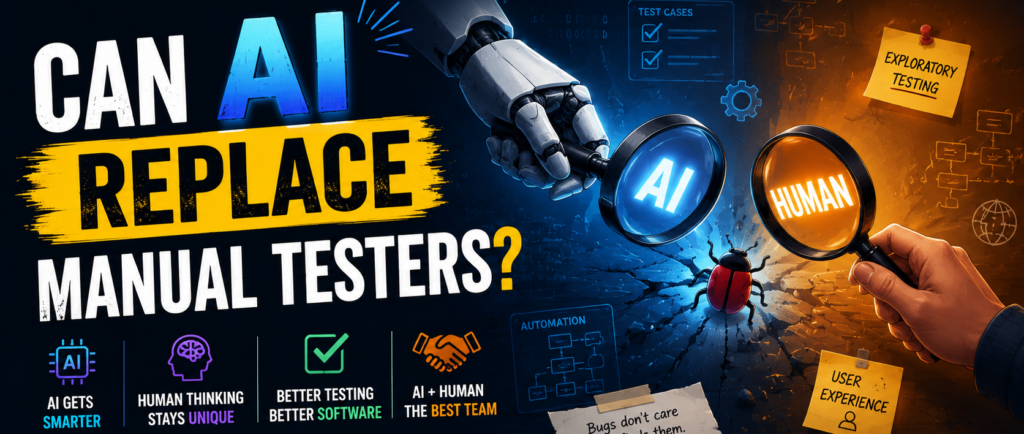
Can AI Replace Manual Testers?
I have only a few months of experience in QA, but this is something I hear very often:
“AI will replace manual testers.”
At first, this statement sounded scary. But after working on real projects, finding bugs, testing features, and understanding how users actually use applications, my opinion has changed.
Short Answer
No, AI cannot completely replace manual testers.
Can AI help testers? Absolutely.
Can AI reduce some manual work? Yes.
Can AI understand users, think creatively, and find every real-world issue on its own?No, Not yet.
What AI Is Really Good At
AI is amazing at handling repetitive tasks.
Some examples:
✅ Generating test cases
✅ Writing automation scripts
✅ Creating test data
✅ Summarizing bug reports
✅ Explaining application flows
✅ Finding common edge cases
As a beginner QA, I use AI almost every day to save time. Tasks that used to take 30 minutes can sometimes be done in 5 minutes.
Honestly, AI feels more like a helpful teammate than a replacement.
What AI Still Struggles With
Software is built for humans.
Humans can be unpredictable.
Imagine a user who:
- Clicks buttons in a strange order
- Uses the application differently than expected
- Misunderstands instructions
- Tries unusual combinations of actions
These situations often reveal real bugs.
AI can suggest possibilities, but manual testers often discover issues through curiosity and exploration.
And sometimes the best bug is found by simply thinking:
“What happens if I do something nobody expected?”
Bugs Don’t Always Follow Rules
In my short QA journey, I noticed that many bugs appear because of:
- Business logic misunderstandings
- Requirement gaps
- User behavior
- Design inconsistencies
- Unexpected workflows
These are not always easy for AI to detect.
A tester can ask questions like:
- Does this feature make sense?
- Is this what the client wanted?
- Will users understand this screen?
- Is the experience smooth?
Those questions require human judgment.
AI Doesn’t Attend Requirement Meetings 🙂
One funny thing I realized:
AI can read requirements.
But it doesn’t sit in discussions where requirements keep changing every day.
Many times the challenge is not testing the feature.
The challenge is understanding what the feature is actually supposed to do!
QA engineers often act as:
- Testers
- Investigators
- Requirement validators
- User advocates
That human communication is difficult to replace.
What Will Happen to Manual Testing?
I think manual testing will evolve rather than disappear.
Future testers will need skills like:
- Understanding AI tools
- Automation basics
- Exploratory testing
- Critical thinking
- Product understanding
- Communication skills
The role may change, but the need for quality assurance will remain.
My Personal Opinion
As someone who is still learning QA, I don’t see AI as a threat.
A tester who ignores AI may struggle in the future.
A tester who learns how to use AI effectively will become faster, smarter, and more productive.
The future is probably not:
❌ AI vs Testers
The future is:
✅ AI + Testers
And that combination can build better software than either one alone.
So, can AI replace manual testers?
My answer is no. It can assist testers, improve productivity, and automate repetitive work, but human curiosity, judgment, and real-world thinking are still irreplaceable.