Website Design

SINCE 2013

10th February 2026

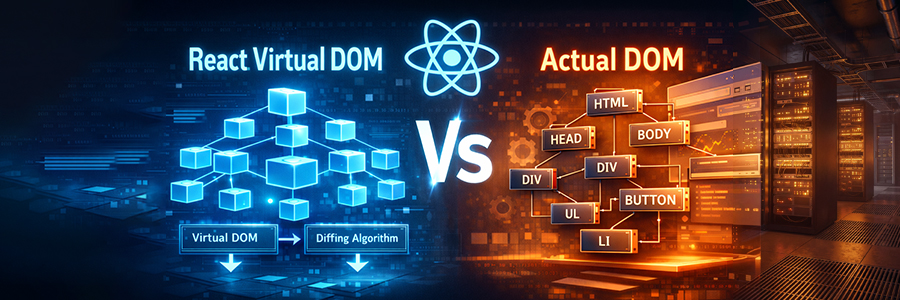
Understanding React’s Rendering Engine: Virtual DOM vs Real DOM

Modern web development—particularly when working with React—relies on an interesting interaction between two key ideas: the Real DOM (Document Object Model) and the Virtual DOM. These mechanisms form the foundation of how React smartly handles changes and updates to a web page’s structure and content while maintaining high performance. Real DOM vs Virtual DOM: A Clear Comparison Definition Updates Coupling with Browser Representation Rendering Manipulation Performance Developer Experience Cross-Platform Support Efficiency & Optimization Diffing & Reconciliation: Optimizing UI Updates in React With a clear understanding of the Real DOM and the Virtual DOM, the next step is to see how […]

26th January 2026

React.js Latest Features and Best Practices in 2026

A Complete Guide to Modern React Development React.js remains one of the most powerful and widely adopted JavaScript libraries for building modern user interfaces. With continuous updates focused on performance, concurrency, and developer experience, React in 2026 offers advanced features that help developers build fast, scalable, and maintainable applications. This article covers the latest React.js features, modern best practices, and performance optimization techniques that every React developer should know. Why React.js Is Still Relevant in 2026 React continues to dominate frontend development because of: Companies rely on React for dashboards, SaaS platforms, admin panels, and real-time applications due to its […]
21st January 2026

Tailwind CSS Best Practices for Large Applications

As frontend applications grow in complexity, maintaining a clean and scalable CSS architecture becomes increasingly challenging. Tailwind CSS has emerged as a powerful utility-first framework, but without proper practices, even Tailwind projects can become unwieldy. This guide explores battle-tested strategies for managing Tailwind CSS in large-scale applications. 1. Design Token Management Extend the Default Theme Thoughtfully Rather than overriding Tailwind’s defaults, extend them to maintain consistency while adding your brand’s identity. Use CSS Variables for Dynamic Theming Combine Tailwind with CSS custom properties for features like dark mode or multi-brand support. 2. Component Abstraction Strategies Create Reusable Component Classes Sparingly […]
27th December 2025

Bold Minimalism: How Designers Are Balancing Simplicity with Impact

In an era of information overload, design is no longer about adding more it’s about saying more with less. This shift has given rise to Bold Minimalism, a design approach that blends clean simplicity with strong visual impact. Unlike traditional minimalism, which often feels subtle or quiet, bold minimalism commands attention while remaining uncluttered. What Is Bold Minimalism? Bold minimalism is a modern evolution of classic minimalism. While traditional minimalism focuses on restraint and neutrality, bold minimalism introduces contrast, scale, and confidence. It combines: The goal is simple: clarity without compromise, simplicity with personality. Why Bold Minimalism Is Trending Now […]
25th November 2025

What is Visual Hierarchy and Why is it Important? 

Ever looked at a competitor’s website, business card, or social media post and thought, “Wow, that looks so professional!” while your own designs feel… not quite there? The difference often isn’t fancy graphics or expensive photography; it’s understanding visual hierarchy. Visual hierarchy: The secret to designs that just “work” Think of visual hierarchy as your design’s GPS—it guides your audience’s eyes exactly where you want them to go. When you’re juggling all the pieces of your business, having designs that effectively communicate your message isn’t just nice to have – it’s essential for success. Why nailing visual hierarchy matters to your […]
21st November 2025

The Moment Rust + WebAssembly Entered My React Stack — Game Over

A React application eventually reached its performance limits. It was designed as a web dashboard responsible for processing large data sets in real time: At first, React with TypeScript managed the workload efficiently. However, as the volume of data increased, performance degradation became unavoidable. The UI began to stutter. Scrolling lost smoothness. Filters introduced noticeable delay. Even routine operations—such as sorting thousands of table entries—became increasingly slow. Attempts to optimize React through state-management improvements, memoization, and virtualized lists delivered only temporary or minimal gains. Why Rust + WebAssembly? WebAssembly (WASM) had typically been viewed as a technical curiosity—primarily a way […]
13th October 2025

Modern State Management: Evaluating Redux Toolkit, TanStack Query, and Zustand

State Management: For React developers, one question always pops up: ‘What’s the best way to handle state in my app?’ 🤔 React developers have plenty of options, but three libraries consistently shine in real-world applications: 🟥 Redux Toolkit (RTK)🟦 React Query (TanStack Query)🟩 Zustand 🟥 Redux Toolkit (RTK) Redux has been a staple in React development for years. While some developers swear by it, others dread its verbose boilerplate. Enter Redux Toolkit — transforming Redux into a much smoother and more enjoyable experience. ✅ When to Use Example ⚠️ Watch Out 🟦 TanStack Query (React Query) React Query isn’t your […]
23rd August 2025

Remix or Next.js? Choosing the Right Framework for Your Web App

In the fast-paced world of modern web development, selecting the right framework can make all the difference in building robust, scalable, and high-performing applications. Among the top contenders, Next.js and Remix stand out for their innovative approaches and growing popularity. Both frameworks offer powerful features that cater to different development needs, but the choice between them often depends on your project’s goals and priorities. In this blog, we’ll provide a comprehensive comparison of Next.js and Remix—covering their features, strengths, and key considerations—to help you make an informed decision for your next project. Understanding Next.js: Next.js has become one of the […]
22nd July 2025

Why Zustand Works Better Than Redux Toolkit in React

As a developer who’s faced a wide range of frontend challenges, choosing the right state management solution became crucial for both my efficiency and peace of mind. Over the years, I’ve experimented with various tools—starting with the classic Redux, moving through the Context API, and eventually adopting Redux Toolkit. While Redux Toolkit was a notable improvement over its predecessor, everything changed when I discovered Zustand. It immediately clicked with me. In this post, I’ll share my personal journey and explain why Zustand ultimately became my go-to over Redux Toolkit. First Encounter with Redux Toolkit When I first used Redux several […]
16th July 2025

The Best Alternatives to Adobe Software in 2025

Adobe has long been the industry leader in creative software, powering everything from photo editing and video production to graphic design and animation. But with rising subscription costs and increasing demand for flexibility, many users—freelancers, students, and even businesses—are seeking affordable and powerful alternatives. In this blog, we’ll break down the best alternatives to the most popular Adobe software, including Photoshop, Illustrator, Premiere Pro, After Effects, InDesign, and more. 🎨 Adobe Photoshop Alternative: Photo Editing & Retouching 1. Affinity Photo (Paid, One-Time) 2. GIMP (Free & Open Source) 🖼️ Adobe Illustrator Alternative: Vector Graphic Design 1. Inkscape (Free & Open […]
16th June 2025

React vs Next.js: The Ultimate Showdown for Modern Web Development

The JavaScript landscape for web development is constantly evolving, and two frameworks, React and Next.js, have emerged as dominant players. But for software engineers facing a project decision, the question arises: which one is better? 1 : Understanding the Fundamentals React: The Building Block Library React, created by Facebook, is a declarative JavaScript library for building user interfaces (UIs). It emphasizes component-based architecture, where complex UIs are broken down into reusable components. Each component manages its own state and renders its UI based on that state. This modular approach promotes code maintainability and reusability. Here’s a breakdown of the core […]